There’s always room for dessert.
That’s my motto. And
there’s no better dessert than a couple of pieces of cookies. I love cookies
because they’re not as heavy as cakes or pies, and it’s easier to bake than any
other dessert I know (who doesn’t love freshly baked desserts?).
For a few days now, I’ve
been itching to try out this recipe I found in Sweet Tooth.
It’s a recipe for S’Mores Cookies,
and they just look so good and so inviting and really, really delicious.

S’mores Cookies
Adapted from Lovin’
From the Oven
1-3/4
cups all purpose flour
1 cup
graham cracker crumbs
1 tsp
baking soda
1 tsp
salt
1 cup
(2 sticks) butter, softened
3/4
cup sugar
3/4
cup brown sugar
2 tsp
vanilla extract
2
eggs
2
cups mini chocolate chips
1-1/2
cups mini marshmallows, or large ones cut up
2
Hershey bars, chopped
Procedure:
1. Preheat oven to 375 degrees
2.
With an electric mixer, beat together the butter
and sugars until light and fluffy
3.
Mix in eggs and vanilla to butter mixture until
combined
4.
In a large bowl, whisk together flour, graham
crackers, salt, and baking soda
5.
Add the flour mixture to the butter mixture and
mix well
6.
Stir in the chocolate chips
7.
Use 2 tablespoons or a medium-sized ice cream
scoop to drop rounded tablespoons of dough onto cookie sheets
8.
Bake for 8 minutes and remove from oven. Push a
few marshmallows and pieces of chocolate into each cookie and return to the
oven to bake an additional 3-4 minutes.
9.
Cool cookies on a wire rack (or just hand them
over steaming hot to your hungry friends)
Recipe yields about 3
dozen cookies

Photo Credit: [2]
Even though I know this
recipe will be a hit with everyone, some will resist trying out these cookies.
People now are more conscious of their health and weight and are more resistant
to the temptation of cookies (and desserts) than ever before.
In an effort to maintain,
gain, or reduce weight, people are coming up with different and creative ways
to do so. Some people try different types of diets, some resort to extensive
exercise programs, while others choose to buy new cutlery in order to trick
their brain (and themselves)into thinking that they’re eating less/more.
I
watched a documentary a few years back about a woman who was trying to lose
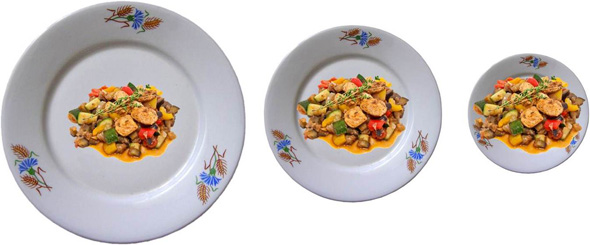
weight. She said that using smaller plates instead of the standard sized ones (9"-10") helped
reduce the amount of food she served herself and the amount of food she ate.
This could have something to do with her perception of how much she was putting
on her plate. Given a particular amount of food, this may look smaller on a big
plate (where it occupies say, only half of the plate) or larger on a small
plate (where it could fill up the whole plate).

Photo Credit: [3]
A study done by Wansink, van Ittersum, and Painter (2006)found that the size of the container does indeed affect
the amount of food you put in it. Another study done by Penaforte et al. (2013) shows that, on the
contrary, plate size does not affect
a person’s perception of food portion size. One way to see whether or not plate
size affects perception of amount of food is to use the method of Magnitude Estimation.
Magnitude Estimation is a technique developed in 1958 by S.S.
Stevens that accurately measured the relationship between perceived magnitude
intensity and stimulus intensity (Goldstein, 2010). In other words, it tells us
how accurate or inaccurate people are at estimating the true intensity of a
given stimulus.
In a magnitude estimation
experiment, the experimenter will present the participants with a standard
stimulus and its exact intensity. After which the experimenter will present
several other stimuli whose intensities the participants must now guess. In the
case of ‘plate size’ we can have two
conditions: one where the food is placed on a big plate and another where the
same amount of food is placed on a small plate. By doing this we can see if
participants really see food placed on a smaller plate as more than when the same amount of food is placed
on a larger plate.
There are other researches that tackle the non-edible factors that affect the amount of food people consume like plate color, table cloth color, cutlery size and color-- but we'll leave that for another time.
References:
Goldstein, E.B. (2010). Sensation and perception (8th ed). Belmont, CA: Cengage Learning.

0 comments:
Post a Comment