A few blog posts ago, I shared my recipe for the Molten Lava Cupcake. When I make this cupcake, I usually just leave it be; no decorations whatsoever. But sometimes, you want to add something extra. And you can do that by adding in icing! Any icing recipe will do, but I love this particular icing recipe from joyceyvonna (notice that she uses a Kitchen Aid too).
Video credit: [1]
There are times when I eat because I'm hungry, and there are those times when I eat, just for the sake of eating, and tasting the food in front of me. These are the times when I savor the sweetness of blueberry or the cookie butter, or the bitterness of dark chocolate, or the explosion of textures and flavors in a Philadelphia roll.

Photo Credit: [1]
But haven't you ever wondered how you perceive all these different and wonderful flavors?
Whenever you eat, the first place your food comes into contact with is your tongue, and stimulates the receptors. This is where the magic in your mouth happens. This is where the perceptual process of tasting starts.

Photo Credit: [2]
The surface of our tongue is full of structures called papillae, which can be divided into four kinds: filiform papillae (found over the entire surface of the tongue), fungiform papillae (found at the tip and the sides of the tonge), foliate papillae (folds found at the back and at the sides), and circumvilliate papillae (found at the back). These papillae, with the exception of the faliform papillae contain taste buds which have taste cells. At the tip of these taste cells are taste pores where transduction happens when chemicals come in contact with the receptors there. The electrical signals generated in these taste cells are then transmitted from the tongue in a number of different nerves that send this information to the brain (Goldstein, 2010).

Photo Credit: [3]
This may seem like a straightforward path to perceiving flavor, but as we learned this past semester, the senses don't work independently, they work together, and most of the time, information from the gustatory and the olfactory receptors work together to perceive what we know as flavor. If you've ever been sick with the sniffles, or had runny nose, you'll know that trying to eat something when you can't smell anything, results in a bland taste. This just shows us that we probably mislocate the source of our sensation (of taste) as being in the mouth, because there is physical representation of the food in our mouth, and because we experience tactile sensations associated with chewing and swallowing (Goldstein, 2010).

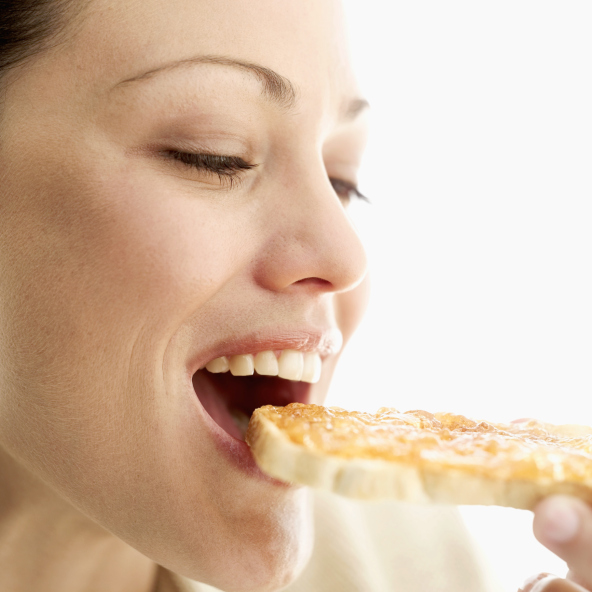
Most of the research about perception of flavor has focused on the orbitofrontal cortext (OFC) because this is where responses from taste and smell are first combined. It is in the OFC where a lot of neurons from the different senses converge, which is why it contains bimodal neurons which respond to more than one sense. These neurons respond to similar qualities, meaning they are tuned to respond to qualities that occur together in the environment. But more than this, the firing of the neurons in the OFC relfect the extent to which an animal will consume a particular food.
Let's say you can't resist the temptation and decide to lick the spatula you used to make icing clean. Before getting a taste of the delicious chocolate icing, there is a great amount of firing of neurons in the OFC. After the first lick, the rate of firing goes down, and when your hunger is abated, and you no long want to eat the icing, firing in the OFC is lowest. According to Edmund Rolls, the responses of the neurons in the OFC are essentially reflecting the pleasantness of the flavor, and in doing so, help control food intake (Goldstein, 2010).
----------------------------------------------
References:
Goldstein, E.B. (2010). Sensation and perception. Belmont, CA: Wadsworth

0 comments:
Post a Comment