_________________________________________________________________________________
------------------------------------------------------------------------------------------------------------
Rituals?
Rituals do not just pertain to those activities which involve offering an alive person in a bonfire! Rituals can be seen in normal life and in daily routines. Rituals can be as simple as like stretching your fingers and arms before typing those academic papers. Rituals can be as conscious as praying before meals, or as unconscious like tapping the pillow before sleeping.
As stated, rituals can be a part of the daily life. In fact, some researches are dedicated to linking rituals to eating behavior, an essential activity in a day. Below is video which demonstrates a connection between ritualistic behavior and food consumption.
This video is in fact one of the inspirations for our study! Vohs, Wang, Gino and Norton's experiment (2013) had the greatest influence in our study. We, the experimenters, are interested on the effect of ritualistic behavior on flavor perception. We hypothesized that the higher number of frequency of the execution of the ritualistic behavior would result to an enhancement of the flavor perception! But what exactly is flavor perception?

Well, there's more to flavor than just mango or orange juice! There's more to flavor than just cookies and cream or rocky road ice cream! There's more to flavor than black forest or dulce de leche cakes.There's more to flavor than those images above!
Flavor was defined as a combination of taste and smell (Goldstein, 2010). According to Lawless (2001, as cited in Goldstein, 2010), flavor pertains to overall impression that we experience from the combination of nasal and oral stimulation. Eating itself, though, would be a complex mixture of many flavors, therefore, many stimulations from many sensations, a ‘complex tapestry’ were pointed out (Reichl, 1994 as cited in Goldstein (2010). In fact, it was because of this multisensory build-up of a flavor concept that the current taxonomy used to define senses was questioned. That was, flavor as a result of combining tastes, smells, as well as tactile, visual, and auditory cues (Auvray & Spence, 2008).
Now, you may wonder how are we going to study the effects of ritualistic behavior on food perception. Well, of course, we need to specify these variables. As for ritualistic behavior, we focused on the tactile rituals. By tactile, it means something involving touch. Just like in eating KitKat, most people try to feel it and break it into two before eating it.
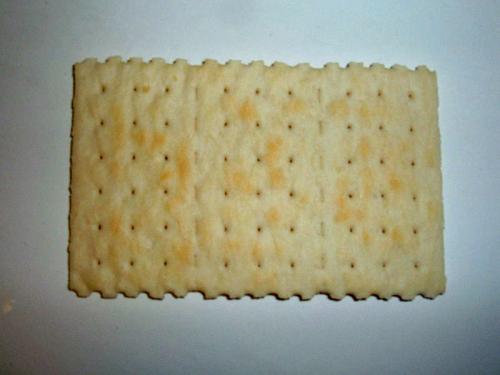
However, in this study, we did not use Kitkat. SkyFlakes was our chosen product because it can be somehow considered as a staple in our culture. And similar to KitKat, the tactile ritual for SkyFlakes was breaking it according to its guidelines. The guidelines were those dashed lines that divided the cracker into three.
SkyFlakes could be perceived as bland in taste. In order for this not to have significant effect on our study, we decided to incorporate cheese in the eating behavior! Thin slices of Eden cheese were provided.

 \
\
The scope of the study didn't end here. We also investigated the effect of being a performer of the ritual and being an observer to the performer on flavor perception. Let's just role assignments for easier reference. :P
What did we mean by performer? Performer pertained to the participants who engaged in the eating behavior. Then, by observer, we meant that the participants who didn't eat but just observed the performers as they indulge in those crackers and slices of cheese. A total of 120 college students participated in our study. They were randomly assigned with role and to which condition: control, first cracker-ritual, all cracker-ritual. The conditions respond to the frequency that the tactile rituals should be performed. There were a total of 3 crackers per set-up. In the control, no tactile ritual should be performed. On the first-cracker ritual, only on the first cracker should the tactile ritual be performed. And on the last, tactile rituals should be performed on all crackers. Feeling flavorful, huh? :D
You may be asking how we gave instructions to the participants. We actually let them watch instructional videos corresponding to which condition they belong to. For the second and third conditions, tactile rituals were incorporated in the videos. The following videos are the ones we used for our study. Enjoy watching!
[Control Condition]
[First Cracker-Ritual/ Second Condition]
[All Cracker-Ritual/Third Condition]
After watching the instructional videos, performer will now eat crackers!!!
But maybe you would think that the knowledge of being observed might affect the way the performers eat. It could be very disturbing when one stares at you while eating! We eliminated this problem by making use of a one-way mirror! Cool, right?

After eating, we asked both performers and observers to answer a questionnaire we constructed to measure flavor perception. Then, they were debriefed about the true nature of our study.
_________________________________________________________________________________
-----------------------------------------------------------------------------------------------------------
Now that the nature of the study is all clear, let's discuss the findings!
Sad to say but, uh, some of our hypotheses were insignificant if we based it from the statistical results of the data responses from our 120 randomly-assigned-to-three-conditions participants. The most saddening one revealed that tactile rituals were not conducive to enhance flavor perception. However, personal involvement with the ritual was significant with a medium effect size. Meaning, those who performed the ritual had higher values for flavor perception than those who just observed the execution of the ritual. This partially supports the findings from Vohs et. al. (2013)'s study. The concern though, was the interaction between tactile rituals and role assignment that was also insignificant. What was that factor that made the significant effect of the role assignments on flavor perception?
We actually inferred some alternative explanations for these results. A possible reason for the insignificance of the tactile ritual on flavor perception was the ritual itself was too plain usual. Though it conformed to the definition of rituals as episodic and symbolic to the crackers, the ritual of breaking could appear too common and unexciting to the participants that it did not elicit any form of flavor stimulation. Even when the frequency of the ritual was increased, it still did not have significant effect. For this matter, the ritual might have been tedious for the participants. Instead of inducing enjoyment, it could be possible that the tactile ritual was too structured that it caused the opposite. As for the insignificance of the interaction, the discrepancy in the results could mean that if tactile rituals, in general, did not elicit significant effect on flavor perception, there might be other factors involved in the role assignments that affect the flavor perception but were not covered to be assessed by this study. One possible factor could be the sound of the breaking crackers. There were no items designated for the effect of this modality on flavor perception (Ang, de Guzman, Pulido & Trazo, 2013).
There were other possible reasons why this study did not yield significant effects despite the extensive literature review being done. Because of that, future researchers are advised to review the methods over and over again. Pre-test is very, very important!
There were other possible reasons why this study did not yield significant effects despite the extensive literature review being done. Because of that, future researchers are advised to review the methods over and over again. Pre-test is very, very important!
So that's it.
We hope you learned!
-------------------------------========*========------------------------------
Ang, Kate Ilene V.
de Guzman, Mary Jane B.
Pulido, Raizza Marie C.
Trazo, Gaea Isabel D.
-------------------------------========*========------------------------------

References:
Images:
http://i48.tinypic.com/30ikpqo.jpg
https://encrypted-tbn2.gstatic.com/images?q=tbn:ANd9GcQqEsZ3EL3I4Mms0F12thcjgbmNLWXJ5vN80OUdXaQUOUVJlRW0zQ
https://encrypted-tbn1.gstatic.com/images?q=tbn:ANd9GcSLohOAlkP4UYiB52pNaMGbNKrHK510EnZcuzYDJC_5y-IxuLhY
http://thumbs.ifood.tv/files/imagecache/reg/photos/skyflakes_cracker.jpg
http://www.benekeith.com/images/food/pringles_1.jpg
http://www.fonterrafoodservices.com.au/media/products/l11173000.jpg
Ang, K. I., de Guzman, M. J., Pulido, R. M., & Trazo, G. I. (2013). Effect of tactile rituals and role assignments on flavor perception. Unpublished manuscript, Department of Psychology, University of the Philippines, Quezon, .
Auvray, M., & Spence, C. (2008). The multisensory perception of flavor [review]. Science Direct Consciousness and Cognition, (17), 1016-1031. doi: 10.1016/j.concog.2007.06.005
Goldstein, E. B. (2010). Chemical senses. In E. Goldstein (Ed.), Sensation and perception
(8 ed., pp. 355-378). Canada: Wadsworth Cengage Learning.
Vohs, K. D., Wang, Y., Gino, F., & Norton, M. I. (2013). Rituals enhance perception
[Abstract]. Psychological Science, doi: 10.1177/0956797613478949

0 comments:
Post a Comment