Sunday, October 13, 2013

An encounter with Praat

Shameless as it may seem, but yes. I am extremely late (haha). Nevertheless, I still wanted to write about this because there is one point in Speech Perception that I’ve come to be fascinated about.

It all boils down to my past. Linguistics.

Yes. I was a Linguistic Major for two years (though I was really supposed to be an HRIM major, long story. Nevermind). And would you believe that I shifted to psychology out of impulse while I was passing by AS 101? *please don’t judge me haha* Anyway, what I really like to discuss is the spectrogram, oh yes, the never-ending affair of linguists with spectrograms, which I never thought I would encounter again in my life as a psychology major.

But before any spectrogram convo, when I was still an innocent UP student, my life as a linguistics major was filled with phonemes, morphemes, semantics, syntax, and all those kind of ideas that I never thought it existed. Phonemes were especially fun because we managed to have an International Phonetic Alphabet (Version 2005), a chart of phonemes where all the sounds by almost all of the recognized languages all over the world are arranged in a chart, depending on how it is pronounced. Those were the basics that one will learn in Lingg110. It was also thanks to this that now I know how to pronounce the alveolar trill [r] just like how you pronounce the first r’s in Spanish words. Just put the tip of your tongue just above your upper teeth and then blow out air. I tried it a lot of times and now I’m an expert in Rrrrrrr!


Anyway, back to spectrograms. For linguists, they usually use a computer software program called Praat to generate spectrograms from their recording participants. This is what is used in studying certain language features like secondary stress, tone of voice in a word vs sentences, pitch, etc. For example, there is a difference in terms of peak of pitch position and in terms of syllable durations when it comes to pronouncing [magna’nakaw] ‘stealing’ and [mag’nanakaw] ‘stealing’. Between the two, given that the apostrophe marks the stress, which between the two is the action of stealing? Which between the two is the human who steals? How about [ˌmaŋɪŋɪsˈda] and [maˌŋɪŋɪsˈda]?


For a linguist, how he or she deals with this kind of stress problem is through recording the two words and then having the participant choose which is the action of stealing and which is the human who steals. This is just so that the perception of speech meaning based on acoustic signals and some top-down processing factors is also accounted for the study. So in essence, this is a somehow psycholinguistic approach of studying speech perception and at the same time grammar of Tagalog. I wonder if this is possible to happen for Psych 145 or Psych 135 itself for that matter? Or what if the syllable duration falls longest on the syllable which the participant did not perceive as a word meaning pertaining to that certain longest syllable? This can therefore suggest that in Tagalog language, two words can have the same kind of phonemes, but then the pitch and duration were changed, further changing the meaning of the word (minimal pairs). Or what if even if pitch and duration were changed, it doesn’t really matter as long as the word said was mutually intelligible? For example, saying [maa’lam] and [ma’alam] ‘know well about something’ need not be explained further that its meaning is the same, so although the stimuli feature was changed, our knowledge of meanings changed the whole story – therefore an interaction of bottom-up and top-down processing!

Can I just say that for the past few days all that is happening in my surroundings, some sort of 135 concept pops up in my mind? For example, when a friend asks me if a certain food was nice, I’m not going to say anything because I don’t want his perception of flavor to be affected in a top-down process way by what I will say. When Lenard, Jane, and I were eating in McDo and were talking about the differences in sweetness of the Heinz tomato ketchup sachets via the number indicated in the sachet. We tried to taste the difference between level 1 and level 4 but there was nothing. Then we thought probably that there’s a threshold of sweetness since the level goes up to 7! This has nothing to do with speech perception! But this is something that is going on for the past few weeks in my mind and I really need to share this!


And that ends my extremely super-duper shameless late post for the blog for the fourth exam. Mehehe.

==Kate Ilene V. Ang==

References:
Goldstein, E. B. (2010). Chemical senses. In E. Goldstein (Ed.), Sensation and perception 
         (8 ed., pp. 355-378). Canada: Wadsworth Cengage Learning.
Saturday, October 12, 2013

Not your ordinary TWIST, LICK AND DUNK!

_________________________________________________________________________________
------------------------------------------------------------------------------------------------------------
Rituals?
Rituals do not just pertain to those activities which involve offering an alive person in a bonfire! Rituals can be seen in normal life and in daily routines. Rituals can be as simple as like stretching your fingers and arms before typing those academic papers. Rituals can be as conscious as praying before meals, or as unconscious like tapping the pillow before sleeping. 

As stated, rituals can be a part of the daily life. In fact, some researches are dedicated to linking rituals to eating behavior, an essential activity in a day. Below is video which demonstrates a connection between ritualistic behavior and food consumption.


This video is in fact one of the inspirations for our study! Vohs, Wang, Gino and Norton's experiment (2013) had the greatest influence in our study. We, the experimenters, are interested on the effect of ritualistic behavior on flavor perception. We hypothesized that the higher number of frequency of the execution of the ritualistic behavior would result to an enhancement of the flavor perception! But what exactly is flavor perception?


Well, there's more to flavor than just mango or orange juice! There's more to flavor than just cookies and cream or rocky road ice cream! There's more to flavor than black forest or dulce de leche cakes.There's more to flavor than those images above!  

Flavor was defined as a combination of taste and smell (Goldstein, 2010). According to Lawless (2001, as cited in Goldstein, 2010), flavor pertains to overall impression that we experience from the combination of nasal and oral stimulation.  Eating itself, though, would be a complex mixture of many flavors, therefore, many stimulations from many sensations, a ‘complex tapestry’ were pointed out (Reichl, 1994 as cited in Goldstein (2010). In fact, it was because of this multisensory build-up of a flavor concept that the current taxonomy used to define senses was questioned. That was, flavor as a result of combining tastes, smells, as well as tactile, visual, and auditory cues (Auvray & Spence, 2008).

Now, you may wonder how are we going to study the effects of ritualistic behavior on food perception. Well, of course, we need to specify these variables. As for ritualistic behavior, we focused on the tactile rituals. By tactile, it means something involving touch. Just like in eating KitKat, most people try to feel it and break it into two before eating it. 


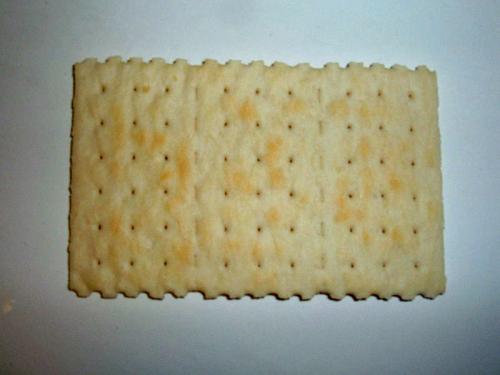
However, in this study, we did not use Kitkat. SkyFlakes was our chosen product because it can be somehow considered as a staple in our culture. And similar to KitKat, the tactile ritual for SkyFlakes was breaking it according to its guidelines. The guidelines were those dashed lines that divided the cracker into three. 

 SkyFlakes could be perceived as bland in taste. In order for this not to have significant effect on our study, we decided to incorporate cheese in the eating behavior! Thin slices of Eden cheese were provided. 
\
The scope of the study didn't end here. We also investigated the effect of being a performer of the ritual and being an observer to the performer on flavor perception.  Let's just role assignments for easier reference. :P

What did we mean by performer? Performer pertained to the participants who engaged in the eating behavior. Then, by observer, we meant that the participants who didn't eat but just observed the performers as they indulge in those crackers and slices of cheese. A total of 120 college students participated in our study. They were randomly assigned with role and to which condition: control, first cracker-ritual, all cracker-ritual. The conditions respond to the frequency that the tactile rituals should be performed. There were a total of 3 crackers per set-up. In the control, no tactile ritual should be performed. On the first-cracker ritual, only on the first cracker should the tactile ritual be performed. And on the last, tactile rituals should be performed on all crackers. Feeling flavorful, huh? :D

You may be asking how we gave instructions to the participants. We actually let them watch instructional videos corresponding to which condition they belong to. For the second and third conditions, tactile rituals were incorporated in the videos. The following videos are the ones we used for our study. Enjoy watching!

[Control Condition]


[First Cracker-Ritual/ Second Condition]


 [All Cracker-Ritual/Third Condition]

After watching the instructional videos, performer will now eat crackers!!!

But maybe you would think that the knowledge of being observed might affect the way the performers eat. It could be very disturbing when one stares at you while eating! We eliminated this problem by making  use of a one-way mirror! Cool, right? 


After eating, we asked both performers and observers to answer a questionnaire we constructed to measure flavor perception. Then, they were debriefed about the true nature of our study.
_________________________________________________________________________________
-----------------------------------------------------------------------------------------------------------
Now that the nature of the study is all clear, let's discuss the findings!

Sad to say but, uh, some of our hypotheses were insignificant if we based it from the statistical results of the data responses from our 120 randomly-assigned-to-three-conditions participants. The most saddening one revealed that tactile rituals were not conducive to enhance flavor perception. However, personal involvement with the ritual was significant with a medium effect size. Meaning, those who performed the ritual had higher values for flavor perception than those who just observed the execution of the ritual. This partially supports the findings from Vohs et. al. (2013)'s study. The concern though, was the interaction between tactile rituals and role assignment that was also insignificant. What was that factor that made the significant effect of the role assignments on flavor perception?

We actually inferred some alternative explanations for these results. A possible reason for the insignificance of the tactile ritual on flavor perception was the ritual itself was too plain usual. Though it conformed to the definition of rituals as episodic and symbolic to the crackers, the ritual of breaking could appear too common and unexciting to the participants that it did not elicit any form of flavor stimulation. Even when the frequency of the ritual was increased, it still did not have significant effect. For this matter, the ritual might have been tedious for the participants. Instead of inducing enjoyment, it could be possible that the tactile ritual was too structured that it caused the opposite. As for the insignificance of the interaction, the discrepancy in the results could mean that if tactile rituals, in general, did not elicit significant effect on flavor perception, there might be other factors involved in the role assignments that affect the flavor perception but were not covered to be assessed by this study. One possible factor could be the sound of the breaking crackers. There were no items designated for the effect of this modality on flavor perception (Ang, de Guzman, Pulido & Trazo, 2013).
There were other possible reasons why this study did not yield significant effects despite the extensive literature review being done. Because of that, future researchers are advised to review the methods over and over again. Pre-test is very, very important!

 So that's it. 

We hope you learned!


-------------------------------========*========------------------------------
Ang, Kate Ilene V.
de Guzman, Mary Jane B.
Pulido, Raizza Marie C.
Trazo, Gaea Isabel D. 
-------------------------------========*========------------------------------


References:
Images:
http://i48.tinypic.com/30ikpqo.jpg
https://encrypted-tbn2.gstatic.com/images?q=tbn:ANd9GcQqEsZ3EL3I4Mms0F12thcjgbmNLWXJ5vN80OUdXaQUOUVJlRW0zQ
https://encrypted-tbn1.gstatic.com/images?q=tbn:ANd9GcSLohOAlkP4UYiB52pNaMGbNKrHK510EnZcuzYDJC_5y-IxuLhY
http://thumbs.ifood.tv/files/imagecache/reg/photos/skyflakes_cracker.jpg
http://www.benekeith.com/images/food/pringles_1.jpg
http://www.fonterrafoodservices.com.au/media/products/l11173000.jpg

Ang, K. I., de Guzman, M. J., Pulido, R. M., & Trazo, G. I. (2013). Effect of tactile rituals and role assignments on flavor perception. Unpublished manuscript, Department of Psychology, University of the Philippines, Quezon, . 

Auvray, M., & Spence, C. (2008). The multisensory perception of flavor [review]. Science Direct Consciousness and Cognition, (17), 1016-1031. doi: 10.1016/j.concog.2007.06.005
Goldstein, E. B. (2010). Chemical senses. In E. Goldstein (Ed.), Sensation and perception 
         (8 ed., pp. 355-378). Canada: Wadsworth Cengage Learning.

Vohs, K. D., Wang, Y., Gino, F., & Norton, M. I. (2013). Rituals enhance perception  
           [Abstract]. Psychological Science, doi: 10.1177/0956797613478949

Monday, September 23, 2013

Mmm, Baby.. That's Spicy!


Whenever I’m out at a Chinese restaurant with my family, my brothers and I always argue about how much chilli we should put in the soy sauce. I like putting a little, but they like having way more chilli than soy sauce- and my tongue can’t handle that! In fact, I find that my family, and most people in general, have an all-or-nothing attitude when it comes to anything spicy in their meals – you either use the Extra Hot Tabasco, or you don’t use Tabasco at all. I think it’s probably why Mildly Hot Tabasco is so unpopular; if you’re going to put hot sauce, you might as well go all the way!

This might make those who hate the spicy feeling wonder – why do people love spicy foods so much? Psychologists can answer this. You might think that the answer lies somewhere in the study of our taste buds and taste receptors, but spicy foods are actually more related to our pain receptors.
Skip ahead to 10:40 in the below video to see a little bit of the research chef Heston Blumenthal did on chilli and pain (or just watch the whole video to see his take on Chili Con Carne – just make sure you’re not hungry! J)

(Bonus: at 15:00 he conducts a little perception psychology with our friends Kiki and Buba, and on 20:00 we get to see one of the many uses of gas chromatography!)

To expand a little more on what they’ve said: Basically, chilli and spicy foods stimulate receptors in our tongue – specifically, pain receptors or nociceptors. Nociceptors respond to different things, like mechanical simulator, chemical simulation, and thermal simulation. The more capsaicin there is in the chilli (or the higher the Scoville level, the measure of spiciness/heat that Blumenthal keeps talking about, if you have a hard time deciphering his accent), the more the nociceptors are stimulated. For reference, the regular Tabasco brand hot sauce hits from around 2,500 to 5,000 SHU (Scoville Heat Units); in the video, they used capsaicin levels of over one million!


Scientists still aren’t completely sure how exactly the process goes from our nociceptors to our brain, although a bunch of models have been proposed, such as the gate control model. The idea behind this model is that the pain signals begin in the spinal column, and then travel through different “gates” or pathways to get to the brain – and that opening or closing these gates controls the strength of the pain signal. Although it is a good model, research today suggests that it is a lot more complex.

What scientists do know is that pain activates a lot of areas in the brain – in the video, the fMRI clearly shows a number of different areas being activated across the whole of the brain, not in just one area. This is what researchers refer to as the pain matrix, and it includes the hypothalamus, the amygdala, the thalamus, areas in the cortex, and prefrontal cortex... there is no one single “pain center” in the brain; it’s all spread out.


Of course, this only partly answers our question – if pain is supposed to be avoided, then we shouldn’t like spicy foods at all! But, as it turns out, a lot of people do – in the same way that a lot of people like getting massages, or biting down on a painful tooth, or scratching your legs after a long day in jeans...but this isn’t to say that if you like spicy foods, you’ll like getting shot in the foot! The Scoville levels of almost all chilis and spicy foods are low enough not to cause true pain; this is just a tiny burn... and a lot of people like that, and nobody is really sure why (yet!). Call them adventurous, intrepid, or masochistic - they just like spice!

Reference: 

Goldstein, E. B. (2010). Sensation and Perception. Belmont, CA: Wadsworth, Cengage Learning.


Feels yummy!

Have you ever thought about what yummy feels like? Is there such thing as just the right amount of softness of firmness in food? The answers is a scrumptious yes. The tongue is not only for tasting delicacies. It also serves as our sense of touch in tasting food. (Hadhazy, 2011) Simple demo? What do you prefer, a chunky or smooth peanut butter? Or how about that crunchy and breaking sensation you feel in you mouth when you eat chips?


But we already know that we feel with our tongue, either from our past food blog entries or simply by our experiences. If you still don't trust me, there is a specific brain region, somatosensory cortex in the parietal lobe for the tongue itself. This part where the human body is represented ina small area for the brain is called the homonculus. Not the mouth, the tongue. (Goldstein, 2010) So let's explore if our perception of food can be affected by the things we touch with our bare hands. Every year, consumer research like those of Starbucks and other fast food chains spend enormous amount of money on disposable packaging. However, does packaging affect our food experience? In 2008, Aradhna and Morrin discovered that "flimsy" packaging may indeed have a negative effect on consumers. In their research, they sorted individuals into "strong autotelics" (people who like to touch products before buying them) vs. "low autotelics" (people who are not so touchy when buying things). This pretest was done since there is individual differences in touch sensitivity. Participants were asked to evaluate the cups and results showed that, low autotelics are highly affected by the packaging. They gave the most negative response to the taste of water in a flimsy cup as compared to strong autotelics. SAY WHAT? Isn't it more logical that those who like touching things (strong autotelics) be more sensitive and more particular to packaging? Shouldn't they be more affected with those "flimsy cups"?


"High (vs. low) autotelics receive more pleasure from touching objects, tend to touch them more, and are more consciously aware of the potential effect of haptic clues on product judgment. As a result, they are more capable of adjusting for such clues in their product judgments when they are nondiagnostic in nature." - Aradhna and Morrin, 2008.

Simply put, strong autotelics adjust more easily than low autotelics. Makes sense? Remember, the concept of experience dependent plasticity? The more you are stimulated by a stimulus the more adept you become. This may explain why strong autotelics have high adaptation to the flimsy cups and thus the results of the study. But going back to food perception, the study showed that packaging do affect our food experience. The way we feel with our tongue also extends to the way we feel with our hands. Thus, there is such a thing as the feeling of yummy! This is linked to the multi-perception of food! We don't just depend on our gustatory sense if something is delicious, we are affected by our olfactory, audio (past blog article entry by me), visual and even somatosensory stimuli. 


References:

Aradhna Krishna and Maureen Morrin, "Does Touch Affect Taste? The Perceptual Transfer of Product Container Haptic Cues." Journal of Consumer Research: April 2008.

Goldstein, E. B. (2010). Sensation and Perception. Belmont, CA: Wadsworth, Cengage Learning.


Hadhazy, A. (2011, December 30). Tip of the Tongue: Humans May Taste at Least 6 Flavors. Retrieved September 22, 2013, from Live Science: http://www.livescience.com/17684-sixth-basic-taste.html


University of Chicago Press Journals (2008, March 18). Does Touch Affect Flavor? Study Finds That How A Container Feels Can Affect Taste. ScienceDaily. Retrieved September 23, 2013, from http://www.sciencedaily.com­/releases/2008/03/080317095610.htm 

Images used:

Picture 1: http://i.imgur.com/DcDM9.jpg

Picture 2: http://www.appliancesonlineblog.com.au/wp-content/uploads/2012/03/Coffee-question.jpg

Picture 3: http://1.bp.blogspot.com/-3VtUe6-30u8/Ud1hE023ReI/AAAAAAAAH5o/ytvWaV0renY/s1600/roger-shepard_5senses_1974.jpg
Sunday, September 22, 2013

Let's get physical: the taste system

Who can resist chocolate?

A few blog posts ago, I shared my recipe for the Molten Lava Cupcake. When I make this cupcake, I usually just leave it be; no decorations whatsoever. But sometimes, you want to add something extra. And you can do that by adding in icing! Any icing recipe will do, but I love this particular icing recipe from joyceyvonna (notice that she uses a Kitchen Aid too).


Video credit: [1]

There are times when I eat because I'm hungry, and there are those times when I eat, just for the sake of eating, and tasting the food in front of me. These are the times when I savor the sweetness of blueberry or the cookie butter, or the bitterness of dark chocolate, or the explosion of textures and flavors in a Philadelphia roll.


Photo Credit: [1]

But haven't you ever wondered how you perceive all these different and wonderful flavors?

Whenever you eat, the first place your food comes into contact with is your tongue, and stimulates the receptors. This is where the magic in your mouth happens. This is where the perceptual process of tasting starts.


Photo Credit: [2]

The surface of our tongue is full of structures called papillae, which can be divided into four kinds: filiform papillae (found over the entire surface of the tongue), fungiform papillae (found at the tip and the sides of the tonge), foliate papillae (folds found at the back and at the sides), and circumvilliate papillae (found at the back). These papillae, with the exception of the faliform papillae contain taste buds which have taste cells. At the tip of these taste cells are taste pores where transduction happens when chemicals come in contact with the receptors there. The electrical signals generated in these taste cells are then transmitted from the tongue in a number of different nerves that send this information to the brain (Goldstein, 2010).
Photo Credit: [3]

This may seem like a straightforward path to perceiving flavor, but as we learned this past semester, the senses don't work independently, they work together, and most of the time, information from the gustatory and the olfactory receptors work together to perceive what we know as flavor. If you've ever been sick with the sniffles, or had runny nose, you'll know that trying to eat something when you can't smell anything, results in a bland taste. This just shows us that we probably mislocate the source of our sensation (of taste) as being in the mouth, because there is physical representation of the food in our mouth, and because we experience tactile sensations associated with chewing and swallowing (Goldstein, 2010).


Photo Credit: [4, 5]

Most of the research about perception of flavor has focused on the orbitofrontal cortext (OFC) because this is where responses from taste and smell are first combined. It is in the OFC where a lot of neurons from the different senses converge, which is why it contains bimodal neurons which respond to more than one sense. These neurons respond to similar qualities, meaning they are tuned to respond to qualities that occur together in the environment. But more than this, the firing of the neurons in the OFC relfect the extent to which an animal will consume a particular food. 

Let's say you can't resist the temptation and decide to lick the spatula you used to make icing clean. Before getting a taste of the delicious chocolate icing, there is a great amount of firing of neurons in the OFC. After the first lick, the rate of firing goes down, and when your hunger is abated, and you no long want to eat the icing, firing in the OFC is lowest. According to Edmund Rolls, the responses of the neurons in the OFC are essentially reflecting the pleasantness of the flavor, and in doing so, help control food intake (Goldstein, 2010).
----------------------------------------------
References:
Goldstein, E.B. (2010). Sensation and perception. Belmont, CA: Wadsworth
Saturday, September 21, 2013

The Thing That Makes You Go, "Hmmmm!"


"Our society is obsessed with the taste of food." 

- Goldstein, 2010

I think this line perfectly describes the existence of Jane’s Kitchenette. When we were planning to establish this blog, we barely had any arguments because we like food. We like the sensations and perceptions associated with food. And even though the choices of topics are limited when explaining the general idea of what’s happening when you sense and perceive, we managed to make it possible to relate ideas to food because as what Goldstein has said, we are obsessed with it.

As there were a lot of foods that we like to it, there are also a bunch of misconceptions that are often linked to food. One of the most common misconceptions is the idea that food is only experienced inside the mouth. In other words, we only taste them and we only use our sensation of taste to perceive it. However, we have this concept called flavor which is closer to food than taste, touch, smell or to any other senses. This has a dual nature and is clearly defined as the combination of taste and smell. The concept of flavor is a clear evidence that when it comes to food, we also use our sense of smell, not just our sense of taste.


If you are the type of person who enjoys the pleasure of drinking aromatic coffee then suddenly you lose your ability to smell its aroma, you would probably feel how smell is so contributory to the enjoyment that you feel whenever you drink the coffee. This is fairly the same to almost all of our food experiences. 


By the way, the condition of inability to smell is called anosmia. This condition is analogous to the experience of having colds and you cannot smell food (therefore, you cannot enjoy it as much) and you also cannot smell anything. It is more common to older people and so they demand more MSGs in their food in order to taste them, which is a not so safe option for anyone’s health condition.


For this entry, I shall stress the point that flavor perception is an explosion of different receptor activations in our olfactory and gustatory system. It was highlighted in Goldstein’s Sensation and Perception that olfaction (smelling) and taste system both exhibit this property of identifying stimuli and discriminating each from one another. 

For olfaction, we are completely aware of how garbage differs from how cooking adobo smells like. We have this aversion towards bad smells and liking for good smells. This is one demonstration of how important olfaction is.


 This is particularly significant for chefs and other cooking enthusiasts (like me). Just from the taste of the food that is on the stove, I for example, have this anticipation whether the food would taste good or bad. For instance in adobo, I know it would taste good if the steam from the pot gives me the sensation of sweet and sour flavor, somewhere between the two. Of course, color plays a role in this situation too. But if you focused it just on your judgment of its smell, you would make your choices whether to add more vinegar, salt, sugar or any other spice. As for cooking rice or baking bread, you would be alarmed once it smells terrible or when you saw that the oven releases grayish black smoke. Smell is also significant in assessing whether the food is already rotten or not.


One problem posed by the olfactory system is the lack of specifying the exact smell of the stimulus. One of the more intriguing facts about odors is that even though humans can discriminate between as many as 100,000 different odors (Firestein, 2001 as cited in Goldstein, 2010), they often find it difficult to accurately identify specific odors. That is why I can’t describe exactly the phenomenon behind the smell of the rice experience.

As for tasting, let us go back to the adobo example. I think our perception of how adobo smells is close to how we would perceive its taste. If it smells sour and sweet alternately but almost simultaneous, it would most likely taste that way too. However, our sensation of taste is more specific than smell. We are more able to identify the property of sweetness, sourness and other types of taste. We have five basic classifications for taste: sweet, sour, salty, bitter and umami (Goldstein, 2010). Sweet compounds cause an automatic acceptance response and also trigger anticipatory metabolic responses that prepares the gastrointestinal system for processing these substances (Goldstein, 2010). For a better elucidation of this statement, let us use the concept of “sugar rush”. We know very well that sugar tastes sweet and sugar rush basically encompasses the hype we experience after an intake of sweet foods. That is a good strategy for Coca-cola company in their advertisement of their softdrinks: Share your happiness. 


On the other hand, bitter compounds have the opposite effect—they trigger automatic rejection responses to help the organism avoid harmful substances (Goldstein, 2010). This is a good explanation towards the taste aversion of kids to ampalaya that is much known for its bitter taste. Generally, kids don’t like vegetables because their bodies do not develop yet enzymes that could break down the compounds and toxins vegetables use as a defense against herbivores.  I got that information from my Bio 1 class and I’m not sure if I still explain it as accurately and as factual as possible. But if this statement is proven to be true, then it could only mean that this property of vegetables plus the specific bitter taste of ampalaya explain why kids don’t like ampalaya. 


Another explanation for bitter taste rejection is our ancestors’ experiences relating poisonous plants and their bitter tastes. Their schemes of this relationship might have been passed on to generation by generation making the ability or preference against bitter taste as evolutionary.

From these examples, we will see the significance of smell and taste in our lives not just in eating but also in other areas. After magnifying the smell and taste aspect of this entry, I shall not shift my focus to flavor which I said awhile ago is the closer term to food. Before reading the chapter of Chemical Senses by Goldstein (2010), I was a member of the bandwagon saying that our experience of flavor is a subjective analysis of all the stimuli we received through our olfactory and gustatory system. But researches that were conducted show that there are genetic differences that affect people’s ability to sense the taste of certain substances. One of the best-documented effects involves people’s ability to taste bitter substance phenylthiocarbamide (PTC). People who can taste PTC are described as tasters, and those who cannot are called nontasters. Recently, additional experiments have been done with a substance called 6-n-propylthiouracil, or PROP, which has properties similar to those of PTC (Lawless, 1980, 2001 as cited in Goldstein, 2010). Researchers have found that about one-third of Americans report that PROP is tasteless and two-thirds can taste it. Genetic studies have shown that PROP and PTC tasters have specialized receptors that are absent in nontasters (Bufe et al., 2005; Kim et al., 2003). This only means that some people taste foods in a more intense state compare to the usual perceived taste for that food. They are sometimes called supertasters. This finding, however, has not been constant or agreed upon by all researches. It only means that further studies need to be conducted so to stabilize its foundation.

From that study, we can infer that flavor is not just confined to our subjective preferences but also, it has its physiological characteristics. After knowing all these things, I was just so amazed and I tried to plot myself in an imaginary spectrum of tasters. I think I belong to the moderate ones. That is a very ‘play safe’ behavior but from what I notice in our family, some members prefer intense taste and others a milder form of it. This is parallel to the ideas of hyper- and hypo-sensitivities. Indeed, every sensation and perception we feel is not some kind of isolation but instead an explosion. 


To end this entry, I would like to use a very short quote that summarizes the vast experience we associate whenever we eat food. I shall explain that the description is applicable to the trio; flavor, taste and smell.

“Eating is more than just sustenance, it is a visceral experience that can be very satisfying or totally disgusting.”


References:
Goldstein, E.B. (2010). Sensation and perception (8th ed). Belmont, CA: Cengage Learning. 


Blog Template by BloggerCandy.com; Edited by SamS