With all the delicious post on food, what do you do to keep fit? Me? I dance.
I know we have all danced at a certain point in our lives. So what kind of dance was it for you? As for me, dancing is one of my passions in life. I've tried belly dancing, hip-hop for sometime, and even Japanese traditional dance! But now, I just adore ballet.
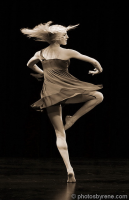
In my ballet class, we are starting to do full pirouettes on one leg, like the one in the picture. It can get pretty painful. Pirouettes are actually challenging since you have to point your toes, keep the other leg up at a right angle, mind your arm position, keep your core tight, maintain your balance and land properly. Whew! And you are not done yet, you have to repeat doing pirouettes and keep practicing. Talk about intense! But that's not all we do in ballet. There's stretching, basic drills such as demi and basic leg & arms position, jumps etc. Try adding gracefulness, stomach in chest out and back straight into all of that. That's an overall workout there! But all these aside have you ever wonder how skilled dancers, are able to do what they do? How are they so precise in their movements and yet so aware of their environment? Well, we go back to perception once again.
A study by Bläsing and collegues in 2012 on Neurocognitive control on dance perception and performance, reviewed and cited studies how dancing enhances skill on proprioceptive senses as well as somatosenses and the ability to coordinate it with visual perception. When in comes to dynamic movements, dancer rely more on their proprioception more than their visual senses as demonstrated by Golomer &
Dupui in 2000. (cited by Bläsing et.al., 2012) However, in stationary balancing skilled dancer seemed to rely on vision cues as showed in the study of Golomer,
Dupui, Sereni, & Monod in 1999 (cited by Bläsing et.al., 2012) An example of this stationary balancing is the technique called spotting. You see dancers do these when they turn, they anchor their gaze on something to keep them focused and balanced. These studies and review are examples of the Ecological Approach on Perception. This talks about how perception occurs in our environment. (Goldstein,
2010) To explain dancing, lets look as the self-produced information. It basically means that our movements gives information on how to continue moving. Does that make sense? As you execute the steps you realize you are near the end of the stage so you adjust your steps and your pacing to avoid falling! Move to see and see to move. Isn't it cool? Breaking down perception and applying it in daily life activities! I hope you guys learned something and keep on dancing or having an active lifestyle!
For now,

Can you think of you own application on self-produced information and how it applies to your "staying-fit activities?"
Feel free to comment below and share your experience on dance, yoga, jog, boxing or which ever activity you do to shed those carbs. :) I hope you enjoy this blog post (I hope you are now interested in dancing) and i promise we will talk about food in the next entries!
References:
Bläsing, B., Calvo-Merino, B., Cross, E. S., Jola,
C., Honisch, J., & Stevens, C. J. (2012). Neurocognitive Cognitive Control
on Dance Perception and Performance. Acta Psychologica, 300-308.
Goldstein, B. (2010). Sensation and Perception.
California: Wadsworth, Cengage Learning.
Image sources:
http://danceadvantage.net/wp-content/uploads/2010/09/turn-renemichaels-129x200.png
http://tututimes.files.wordpress.com/2013/07/keep-calm-and-pirouette-29.png?w=547&h=638

0 comments:
Post a Comment